Private label means the buyer's brand appears on the product, and the question that decides whether it is worth doing is not whether the printing is possible — it is how many layers of the product the brand can reach without paying for a product development programme. A logo on a carton is printing. A logo on the liner, a proprietary series name and a five-year warranty issued in the buyer's name is a brand.
This article sets out what is customisable on a paint protection film order, what each layer costs in practice, where the line falls between private label and genuine ODM, and how to sequence a first private-label order so the tooling spend is proportionate to the volume behind it.
The reference is the SUMEI film range made by Hangzhou Xingtuxintong Automotive Technology Co., Ltd. — X, F and D series on Covestro and BASF aliphatic TPU — which is supplied both as SUMEI brand stock and as private-label goods.
The five layers a brand can reach
Customisation on a film order happens at five distinct layers, and each has its own cost structure. Buyers usually begin by asking about the carton, which is the cheapest and least valuable layer, and never get to the ones that actually differentiate the product in a showroom.
| Layer | What it can carry | Setup cost | Minimum quantity | Brand value |
|---|---|---|---|---|
| 1. Carton | Printed logo, product name, barcode, handling marks | Plate or digital setup, one-off | Per carton run | Low — the end customer rarely sees it |
| 2. Label on roll core | Brand, series name, batch code, thickness, installation QR | Label template, minimal | Per roll | Medium — the installer sees it every time |
| 3. Printed release liner | Repeat logo and series name on the liner itself | Printing plates, higher | By master roll | High — visible during installation, hard to copy |
| 4. Instruction sheet and warranty card | Installation guide, care regime, warranty registration in the buyer's name | Design only | Per order | High — it is where the warranty becomes the buyer's |
| 5. Film specification | Thickness, surface, top coat selected or modified for the buyer's market tier | Development work | By master roll | Highest — this is ODM, not private label |
Layers one to four are printing and documentation. Layer five changes the product. The distinction matters because the first four can be added to any stock series, and the fifth cannot: a 9.5 mil premium film and a 6.5 mil entry film are different constructions on the coating line, not different labels.
What printed liner actually does for a brand
The release liner is the surface the installer peels off before the film touches paint, and it is covered in repeat printing on many premium films for reasons that are commercial rather than technical.
Three of those reasons hold up. First, it makes the film identifiable at the moment of installation, when the roll core label has already been discarded and the film itself carries no marking. Second, it makes counterfeiting harder: a plain liner can be respooled from any source, a printed one cannot. Third, it creates a photographic record — an installer who photographs the liner before installation has documented the brand, the series and often the batch, which is exactly the evidence a warranty claim needs.
The cost side is honest: liner printing requires plates and a minimum run measured in master rolls, so it is a commitment that only makes sense above a certain annual volume. A buyer ordering five rolls does not need printed liner; a buyer ordering a container a year and building a brand does.
For the warranty mechanics that depend on that photographic record, see warranty claims and registration.
Packaging: what to specify and what it costs
Packaging is where most first private-label orders spend money they did not plan for, because carton costs scale in a way rolls do not. A carton run has its own minimum, independent of how much film is in it.
| Item | What to decide | Cost behaviour | Common mistake |
|---|---|---|---|
| Carton | Size per roll count, board grade, print method | Setup plus per-unit; setup is the larger number at low volume | Designing a box for a roll count the buyer will never order again |
| Core label | Content, barcode, batch fields, QR to installation guide | Per-unit, low | Leaving out the batch field, which breaks traceability |
| Instruction sheet | Language set, format, folded or flat | Design plus per-unit printing | One language for a multi-market shipment |
| Warranty card | Issued in whose name, registration route | Per-unit, low; legal content is the real cost | Promising terms the factory has not agreed |
| Shipping marks | Carton markings matching the packing list | Print, minimal | Marks that do not match the invoice, which stops the shipment |
Two decisions save more money than any negotiation. Match the carton to a roll count you will actually reorder — a 12-roll carton designed for a one-off 30-roll order leaves you with packaging you cannot reuse. And settle the language set before design, because adding a sixth language to a printed sheet after approval means reprinting.
Multi-language documentation
Film installation instructions are safety-relevant content: the wrong advice about heat, slip solution or edge sealing produces failures that look like film defects. For a distributor serving several markets, that means the instruction sheet is a translation project, not a design project.
A workable approach is to keep one master document with three parts — a diagram-led installation sequence that is language-neutral, a text block of warnings and care instructions that is translated, and a warranty registration section that is market-specific. The diagram layer rarely changes; the text layer changes per market; the warranty layer changes per legal regime.
Practical sequence for a first order: confirm how many language versions ship in the first container, get a native check on the safety-critical warnings rather than a machine translation, and print the market-specific versions in separate cartons rather than mixing them. Mixed-language cartons in one shipment cause picking errors at the distributor's warehouse that cost more than the printing saved.
Where private label ends and ODM begins
The distinction is not marketing language; it changes what the buyer owns and what the factory has to develop.
| Private label | ODM | |
|---|---|---|
| Product | Existing stock series | Specification developed or modified for the buyer |
| What changes | Printing, packaging, documentation | Thickness, top coat, surface, adhesive, format |
| Development work | None | Sample rounds, trial rolls, testing |
| Minimum volume | The carton and plate minimums | Master-roll quantities per development |
| Time to first shipment | Weeks | Months |
| Who owns the specification | The factory, licensed to the buyer's brand | Negotiable — this is the term to settle in writing |
The last row is where ODM relationships go wrong. If the buyer funds a development and the specification is not contractually theirs, they have paid for a product their supplier can sell to a competitor. Settle exclusivity, term and territory before development starts, not after the first container.
For a first order, private label on an existing series is almost always the right choice: it establishes the brand at low cost and leaves the ODM conversation for the point where volume justifies development. The X Series, F Series and D Series pages list the constructions available as stock, which is the menu a private label starts from.
Beyond film: the same logic on interior parts
The film range is not the only product line where private label applies, and the economics differ. A carton and a label are the whole of film customisation; a floor mat or a seat involves a mould, and a mould is a different kind of commitment.
For interior parts, the private-label layer is usually a colour, a stitch, a logo emboss or a packaging choice on an existing tool, rather than a new tool. Buyers who want a new tool are in a development project, and the cost case has to be made on volume — a mould amortised over a few hundred units is a very different proposition from one amortised over tens of thousands.
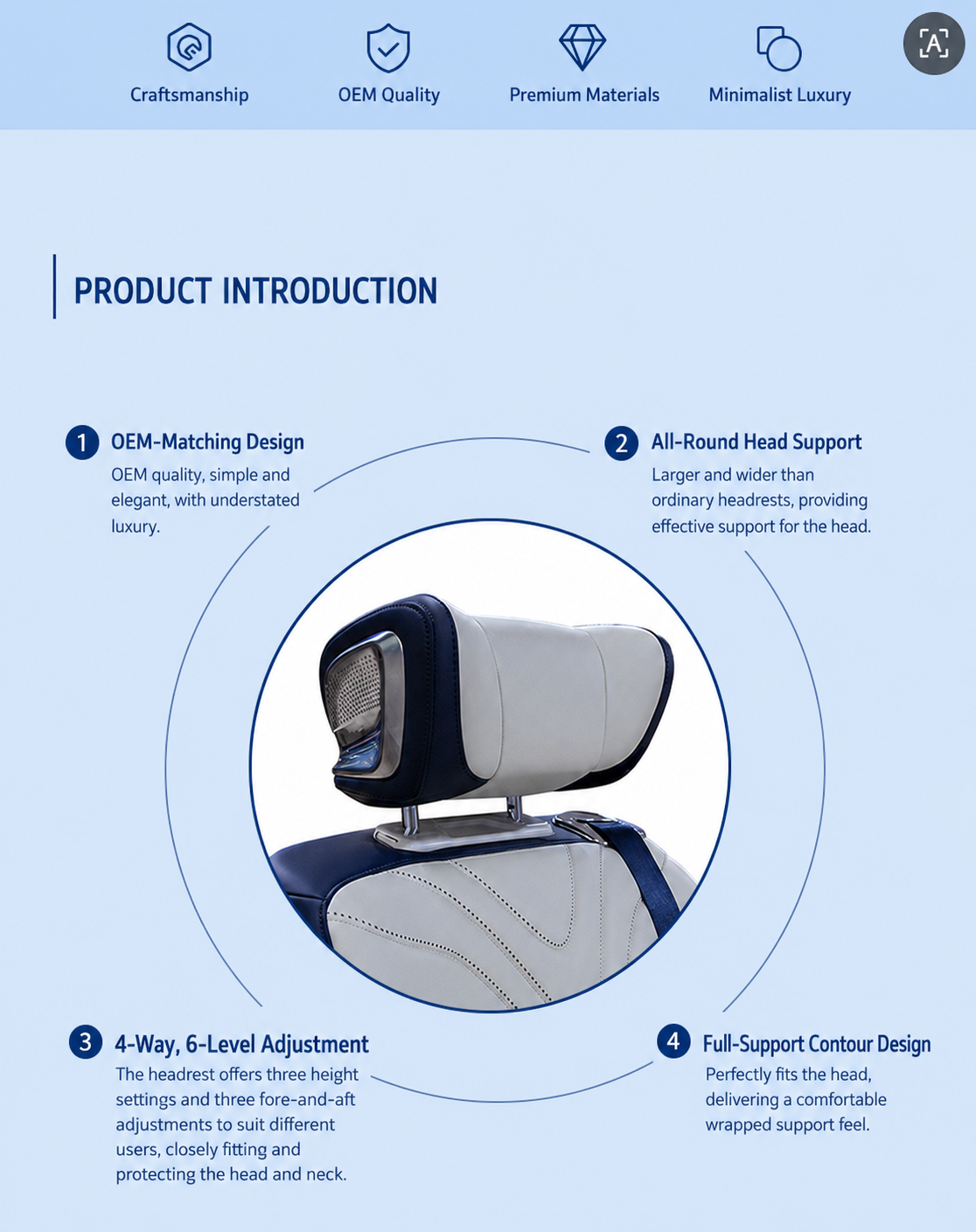
That development economics is covered in floor mat tooling and small-series seat and steering wheel work. The headrest sits in between: a stock product with colour and trim options rather than a new tool, which is why it is the usual first accessory for a distributor testing the interior category.
A private-label order, sequenced
- Choose the series from the stock range by market tier, not by price alone — the entry, mid and premium films serve different customer segments and should not be mixed within one brand tier.
- Decide the layers: carton and core label for a first order; add printed liner and a warranty card once annual volume is known.
- Settle the language set for instructions and warnings, with a native check on safety content.
- Confirm the warranty terms the buyer will issue, and make sure they match what the factory has agreed — this is the most common source of a mismatch between a marketing promise and a supply agreement.
- Approve artwork before the deposit, so production and tooling run in parallel rather than in sequence.
- Order one carton configuration you will reorder, not one designed around an unusual first shipment.
Six steps, and only the second and fourth are genuinely difficult. Most of the cost of a private-label programme comes from doing them in the wrong order.
What to send in the brief
A private-label brief that gets a workable quote answers these: series and thickness, surface finish, roll format, brand name as it should appear, which of the five layers are required, language set for documentation, the warranty terms the buyer intends to issue, first order quantity and expected annual volume, and destination markets.
With those, a factory can price the printing, flag which layers are uneconomic at the stated volume, and say plainly whether the order belongs in private label or in development. Xingtuxintong runs both — the SUMEI brand range as stock, and private label and ODM programmes for distributors and 4S chains. Send the brief through the contact page; the customization and OEM/ODM collection covers the process side, and the MOQ and roll size guide covers the quantities that make each layer work.