
Selling into forty countries is not the same as serving forty markets. The order is the easy part; what determines whether a distributor orders a second time is what happens in the six weeks around it — the sample that arrives before they commit, the documentation that clears customs, the answer to a technical question in a language they can act on, and the claim that gets resolved without a fight.
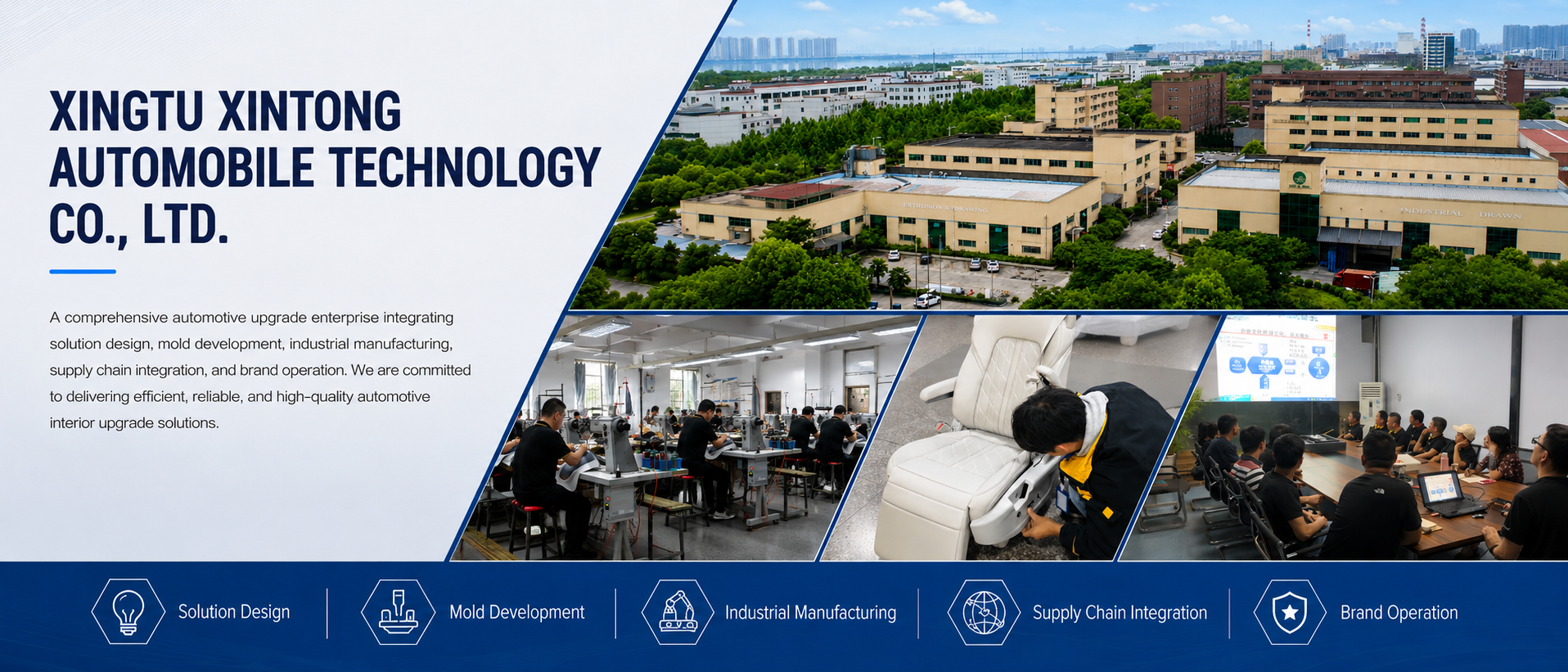
Hangzhou Xingtuxintong Automotive Technology Co., Ltd. supplies film, floor mats and headrests to more than 40 countries across Europe, the Americas, Southeast Asia, the Middle East and Latin America, and has done so since 2018. This note sets out how that service model is actually structured, where the regional differences are, and what a new distributor should expect in the first ninety days.
Two channel models, not one
Almost every overseas relationship falls into one of two shapes, and they have different rhythms.
| Territorial distribution | Project supply | |
|---|---|---|
| Who buys | A distributor or installer network holding stock | A brand, dealer group or programme owner ordering against a specific requirement |
| Order rhythm | Recurring, in mixed series and widths | Campaign or season based, often concentrated |
| What they need most | Availability, technical support, warranty administration | Specification agreement, sample approval, delivery certainty |
| Main failure risk | Stock mix wrong for the local market | Specification drift between the sample and the production run |
| Where the relationship breaks | Rework and warranty volume rising without explanation | A late change nobody documented |
The distinction matters because the support a distributor needs is not the support a project buyer needs. A distributor with stock in a warehouse needs a technical answer within a day and a warranty process that works; a project buyer needs the sample that was approved to be the product that ships. Treating both as "customers" and giving them the same service produces a model that suits neither.
What the first ninety days look like
A new distributor relationship has a predictable sequence, and the value of describing it is that expectations can be set rather than discovered.
- Specification conversation. Which series and thicknesses fit the local market, at what price points, and what coverage packages the installers actually sell. This is where a range is narrowed rather than expanded.
- Samples from current production. Not from a showpiece batch — from the run that is shipping. Evaluating a sample that cannot be reproduced is the most common early mistake.
- Installation trial. The sample should be installed on a real vehicle, ideally by the installer who will use it, in the environment it will be used in. A bench evaluation predicts very little about edge behaviour.
- First order, deliberately narrow. A first order spread across every series is a first order that has not been thought about. One or two series, several widths, enough to run a month.
- Feedback loop. What the installers reported, what the rework rate was, what the customers asked for. This is the step most relationships skip and the one that determines the second order.
The 24-hour response commitment applies across that sequence. It is a response time rather than a resolution time — a technical question gets a substantive answer from someone who knows the product within a day, which is what matters when an installer is standing next to a car with the film half applied.
Regional differences that change the answer
The same product range is asked different questions in different places, and the support model is built around that rather than around a single script.
| Region | What they ask first | What support looks like |
|---|---|---|
| Western Europe | Documentation and warranty administration for lease and fleet channels | Certificates with scope, compliance declarations, claim process discipline |
| North America | Finish range and large-vehicle coverage | Pattern availability for trucks and SUVs; matte and gloss black options |
| Middle East | Heat and dust performance | Specification depth on UV blocking and heat resistance; hydrophobic variants |
| Southeast Asia | Humidity and price tier | Value series; storage guidance for hot, humid warehouses |
| Latin America | Price and installer skill | Entry tiers; installation guidance; smaller order increments |
Two of those are technical in a way that is often missed. In the Middle East, the question is not only whether the film resists heat but whether the adhesive behaves during installation at ambient temperature, which is an installation-environment issue rather than a product-specification one. In Southeast Asia, storage is the underrated variable: a roll stored in an unconditioned warehouse through a monsoon season can arrive at the installer in a different condition from the one it left in, and the cause is moisture rather than manufacturing. Both are covered in installation, thickness and environment.
Samples: the cheapest part of the relationship
Samples are where a relationship is won or lost, and they are also where the most time is wasted. Four rules make them work.
- Sample from current production. A sample that does not match the shipping product is worse than no sample, because it sets an expectation that cannot be met.
- Sample enough to install, not enough to look at. A 200 mm square tells you about gloss and nothing about edge behaviour on a compound curve.
- Sample across the range, not just the top tier. Most volume is not in the premium tier, and evaluating only the premium product produces a price expectation that does not match the market.
- Record the batch. If the installed sample performs well, the batch number is what makes it possible to order that behaviour again.
Sample terms and how they interact with a first order are covered in MOQ, roll sizes and sampling.
Customs and documentation: the part that is not the seller's problem until it is
Every market has its own paperwork, and the recurring failures are the same everywhere: classification, value consistency, documents that name the wrong series, and terms that do not match the invoice.
What a supplier can do about it is limited but real. Three things make a difference.
- Documentation prepared before the order, not after. A compliance declaration and a series data sheet in the destination language should exist on day one, not on request.
- A stated classification with reasoning. The buyer's broker still owns the decision, but a supplier who has shipped the same product into the market can say how it was classified previously.
- Consistency between documents. The invoice, packing list and declaration should be prepared from one order record rather than three.
The full document set by destination is covered in regional standards and certification.
Where the product side meets the service side
For most distributors, the proof of a supplier is not the brochure but the second shipment. Three product arrangements make that second shipment easier.
| Arrangement | What it gives the distributor |
|---|---|
| Batch coding on every carton | A claim can be tied to a batch, and a good batch can be reordered |
| Retained samples per batch | A disputed complaint can be reproduced rather than argued |
| Five-year warranty across all film series | One warranty message to the market, not one per price point |
Those three cost the manufacturer money and are the reason a distributor should look at them before looking at price. A supplier who will not code batches cannot administer a warranty, whatever the terms say. The claim process itself is covered in warranty registration and claims.
What the range looks like from a distributor's side
The SUMEI ladder is arranged so that one stock position can serve several market segments: X Series on Covestro aliphatic TPU, F Series on BASF aliphatic TPU, and D Series with hydrophobic variants, each across 6.5 to 9.5 mil, all with a five-year warranty. Floor mats and headrests sit alongside as accessory lines with their own tooling and lead times.
Hangzhou Xingtuxintong Automotive Technology Co., Ltd. supplies that range from Xiasha, Qiantang District, Hangzhou, with film produced by a partner holding IATF 16949:2016 certification covering thermoplastic polyurethane elastomer functional film manufacturing, and holds its own tooling, moulding and trimming capability in Hangzhou. Distributor enquiries, sample requests and territory discussions are handled through the contact page. The range is on paint protection film, and the company news collection carries the brand launch and the factory note.