
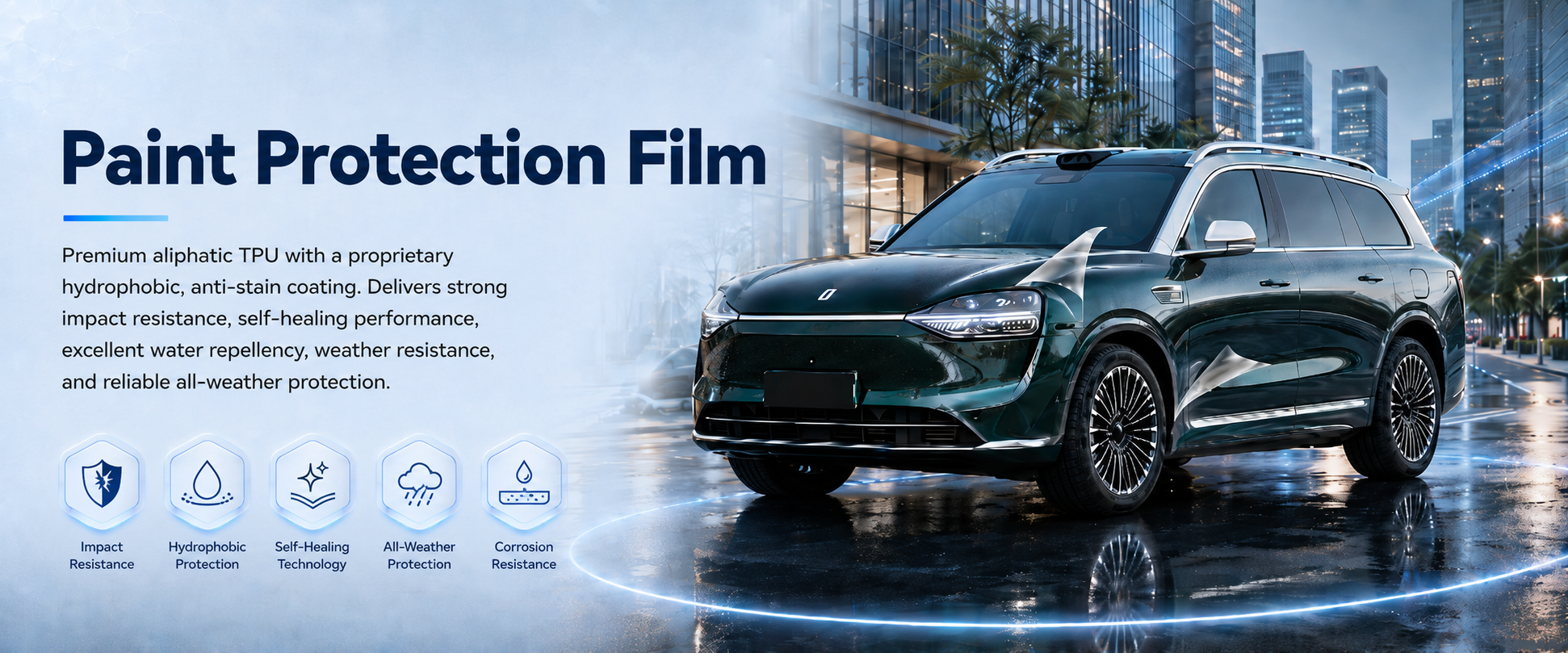
Paint protection film, colour change film and window film are sold through the same channels and installed by the same technicians, which leads buyers to treat them as three colours of the same product. They are three different constructions, and the differences decide what each can be used for. A film specified for one job used on another does not underperform slightly; it fails on a timescale of months.
This article sets out how each construction is built, where the layer that does the work sits, what the headline numbers mean — including the 93% infrared rejection figure that appears on window film specifications — and which substitutions are safe and which are not.
The reference is the SUMEI film range from Hangzhou Xingtuxintong Automotive Technology Co., Ltd., which includes TPU paint protection film, colour change film and high heat-insulation window film. The TPU chemistry behind the protection film is covered in the specification guide; this article is about the family differences.
Three constructions, layer by layer
All three products are multilayer laminates, and the layer order is what defines the product.
| Layer | Paint protection film | Colour change film | Window film |
|---|---|---|---|
| Top functional layer | Self-healing clear coat, hydrophobic | Colour layer plus clear coat | Hard coat, scratch resistant |
| Body layer | Aliphatic TPU, 6.5–9.5 mil | Colour-impregnated or coated polymer | Polyester (PET), often multilayer |
| Functional insert | None | None, or a metallic effect layer | IR-absorbing or IR-reflecting layer; sometimes a metal sputter coat |
| Adhesive | Acrylic pressure-sensitive, removable | Acrylic, sometimes with a repositioning channel pattern | Acrylic, high clarity, low haze |
| Liner | Release liner, sometimes printed | Release liner | Release liner, thin |
The single most consequential difference is the body layer. Aliphatic TPU is used for exterior protection because it is elastomeric: it absorbs impact and recovers, and it does not yellow. PET is used for window film because it is dimensionally stable, optically clear and cheap to coat with functional layers. Colour change film sits between them, and which polymer it uses is the first thing to check.
Why TPU and PET are not interchangeable
The properties that make each polymer suitable are in direct opposition.
| Property | Aliphatic TPU | PET |
|---|---|---|
| Elasticity | High — stretches and recovers | Low — stretches and stays stretched |
| Impact absorption | Good; the reason it protects against stone chips | Poor; a chip transfers through |
| Conformability over curves | High, with heat | Low; complex curves require relief cuts |
| Optical clarity | Good | Excellent |
| UV stability | Good when aliphatic; poor when aromatic | Good |
| Cost | Higher | Lower |
| Typical use | Exterior paint protection | Window film, interior screens, light control |
Two practical consequences. First, a stone chip on PET has nowhere to go: the film does not absorb the energy, so the paint takes it or the film cracks. Second, PET on a curved bonnet needs relief cuts or a pre-cut pattern with seams, which is a legitimate technique for a colour change job and an unacceptable one for a protection job where the customer expects an invisible film.
Which is why the question "is this TPU or PVC" is the correct first question about a colour change film, and why "cast" or "calendered" is the second. Cast film conforms better; calendered film is cheaper and shows more shrinkage over time.
What 93% infrared rejection actually measures
Window film specifications quote total solar energy rejected (TSER), infrared rejection and UV rejection, and the infrared number is the one most often quoted in marketing and least often understood.
| Metric | What it measures | Wavelength range | What it tells a buyer |
|---|---|---|---|
| UV rejection | Blocked ultraviolet | ~300–380 nm | Protection for interior trim and skin; almost all quality films exceed 99% |
| Infrared rejection | Blocked near-infrared | Quoted at a specific wavelength, often 1400 nm | Part of the heat story — but only the near-IR band |
| TSER | Total solar energy rejected across the whole solar spectrum | ~300–2500 nm | The number that predicts cabin heat, because it includes visible and UV |
| VLT | Visible light transmitted | ~380–780 nm | How dark the glass looks; regulated in most markets |
A film quoting 93% infrared rejection at 1400 nm is stating a real measurement of a narrow band. It is not stating that 93% of solar heat is rejected, because roughly half of solar energy arrives as visible light and the near-infrared band around 1400 nm is not where the majority of the energy sits. The honest comparison between two window films is on TSER and VLT together, with the infrared figure as a supporting number.
This matters for a distributor because customers compare the headline numbers across brands. A film at 93% IR and a film at 97% IR may have nearly identical TSER; the difference is often in the wavelength chosen to quote. Ask for the full test report, not the marketing line.
Where the colour layer sits, and why it matters
Colour change film carries its colour in one of three ways, and the method decides how the film ages.
- Coated colour layer under a clear coat — the most common. Colour is applied to the polymer and protected by a clear top layer. Durable, but the top coat quality decides gloss retention.
- Impregnated polymer — colour is in the body layer. Deep and consistent, but harder to change and less flexible in small runs.
- Printed colour — economical and unlimited in pattern, but sensitive to UV and to abrasion; normally used for graphics rather than full wraps.
The installation consequence: a colour change film is judged on how it looks on a whole vehicle, and the colour layer is what catches the light. A cast film wrapped with consistent stretch direction will look even; a calendered film wrapped with inconsistent stretch will show read-through and a mottled finish on a horizontal panel. For a distributor selling a colour range, this is the difference between a satisfied customer and a rework claim.
Which substitutions are safe
Buyers regularly ask whether one film can substitute for another to simplify stock. The honest answer is a short table.
| Substitution | Verdict | Reason |
|---|---|---|
| Gloss protection film in place of matte protection film | Safe, if the customer accepts gloss | Same construction, different top coat |
| Thicker protection film in place of thinner | Generally safe on flat panels | More protection, slightly harder to conform at edges |
| Protection film in place of colour change film | Not a substitution | Protection film is clear; there is no colour to change |
| Colour change film in place of protection film | Only if it is TPU, and only with the customer's knowledge | PVC wrap offers far less impact protection |
| Window film on body panels | Never | PET is not elastomeric; it will crack and offers no chip protection |
| Protection film on glass | Never | TPU is not optically flat enough, and the adhesive is not designed for glass |
The two "never" rows are the ones that appear in real distribution businesses, usually as a stock-shortage improvisation. They are also the ones that generate warranty claims a supplier will decline, because the product was used outside its design envelope.
Reading a series range across the three families
A complete film range for a distributor normally contains all three families, because they sell to different customer intentions rather than to different budgets.
In the SUMEI range, the protection film spans three series on different TPU sources and thicknesses — the X Series on Covestro aliphatic TPU from 6.5 to 9.5 mil, the F Series on BASF aliphatic TPU over the same thickness span, and the D Series from an entry 6.5 mil to a 9.5 mil premium film, with hydrophobic variants at a contact angle of 103 degrees or more. The surfaces include a matte at 22.3 gloss units, a gloss black, and an infrared-rejecting variant quoted at 93% rejection at 1400 nm. Colour change film and high heat-insulation window film complete the range.
The range planning question — which of these a distributor should carry, and in what depth — is covered in planning a film range. The optical side of the protection film, including what gloss units and haze actually measure, is covered in optical clarity and haze.
What to ask before stocking a family
- For protection film: TPU chemistry, thickness, top coat type, adhesive chemistry — see adhesive and liner
- For colour change film: TPU or PVC, cast or calendered, colour layer construction, expected life, and whether the warranty covers removal
- For window film: TSER and VLT together, infrared rejection with the wavelength stated, UV rejection, and the full test report
Three questions for three families, and the answer to each one determines what the product can be sold to do. A distributor who stocks all three without knowing the differences ends up explaining failures to customers instead of features.
Xingtuxintong produces the SUMEI protection, colour change and window film lines in Hangzhou, with the constructions specified per series. The protection range is in paint protection film, and series data is on the F Series and D Series pages. For colour change and window film specifications, ask through the contact page.